Michael
Dunn.

Work
Global creative services — operating model redesign
The challenge
A global creative services team supporting Business Development across the US and Canada had grown organically over time, without a clearly designed operating model behind it. The result was a service with coverage gaps, inconsistent output quality, limited depth in specialist skills, and no structured reporting to show how well it was performing.
Feedback gathered through structured conversations with senior regional stakeholders surfaced specific concerns: delivery windows that didn't reflect the actual complexity of different request types, insufficient quality checking on some work, and a capability gap in one specialist area following a staffing change. Regional leadership needed confidence that the service was resilient, predictable, and on an upward trajectory — and they needed to be able to communicate that to their own teams.
The work had a hard go-live deadline of 1 June 2026, with contractual implications tied to any permanent changes to delivery commitments.
What I did
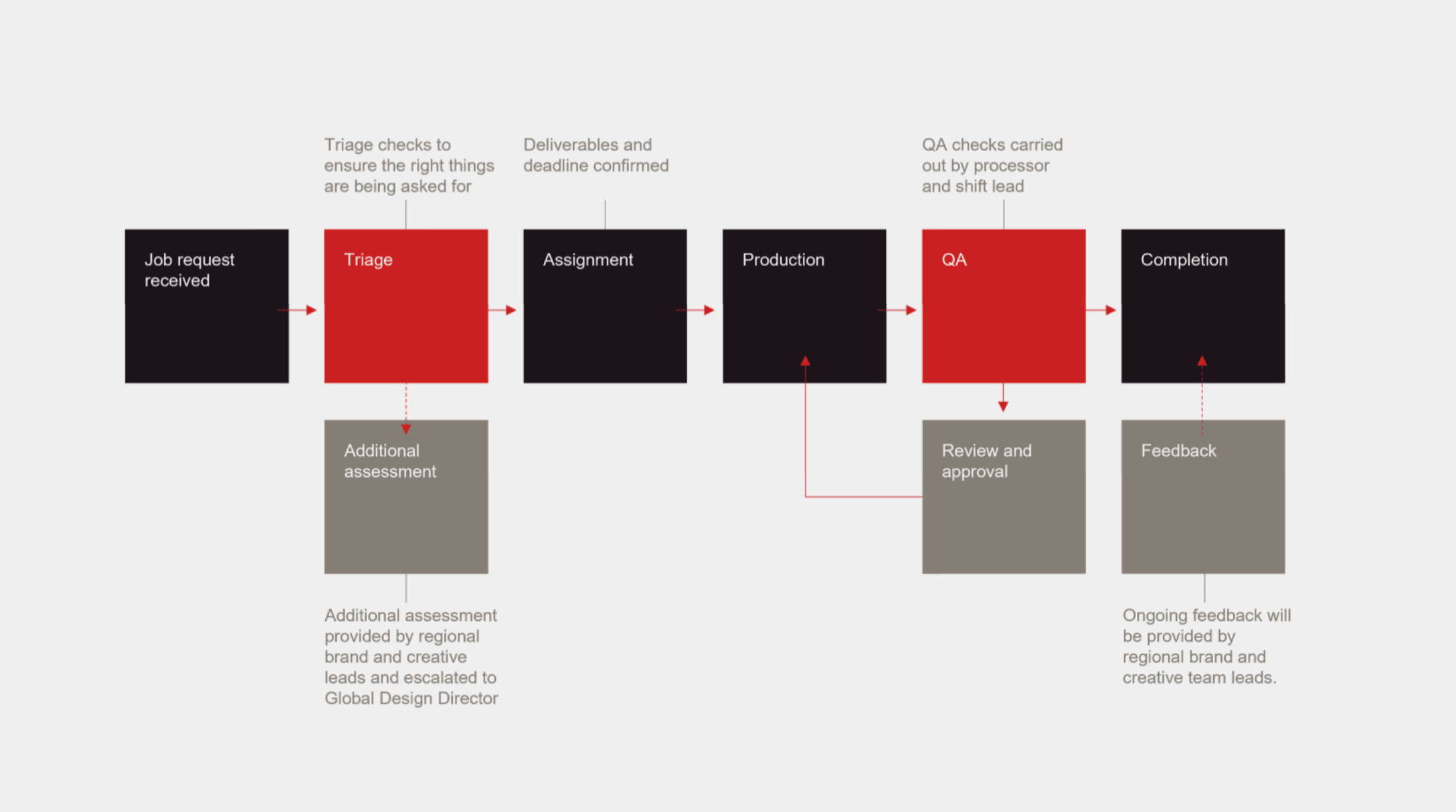
I ran a structured review of the service operating model, working with the delivery team lead and regional subject matter experts to map skills, capacity, and coverage against actual demand. A key part of this was a detailed review of delivery timelines by request type — examining each category of creative output (document production, presentations, social media, email marketing) and identifying where committed turnaround times were misaligned to the real complexity involved. Out of this came a clearer tiering framework, separating standard and complex request paths so that timelines better reflected what was actually being asked.
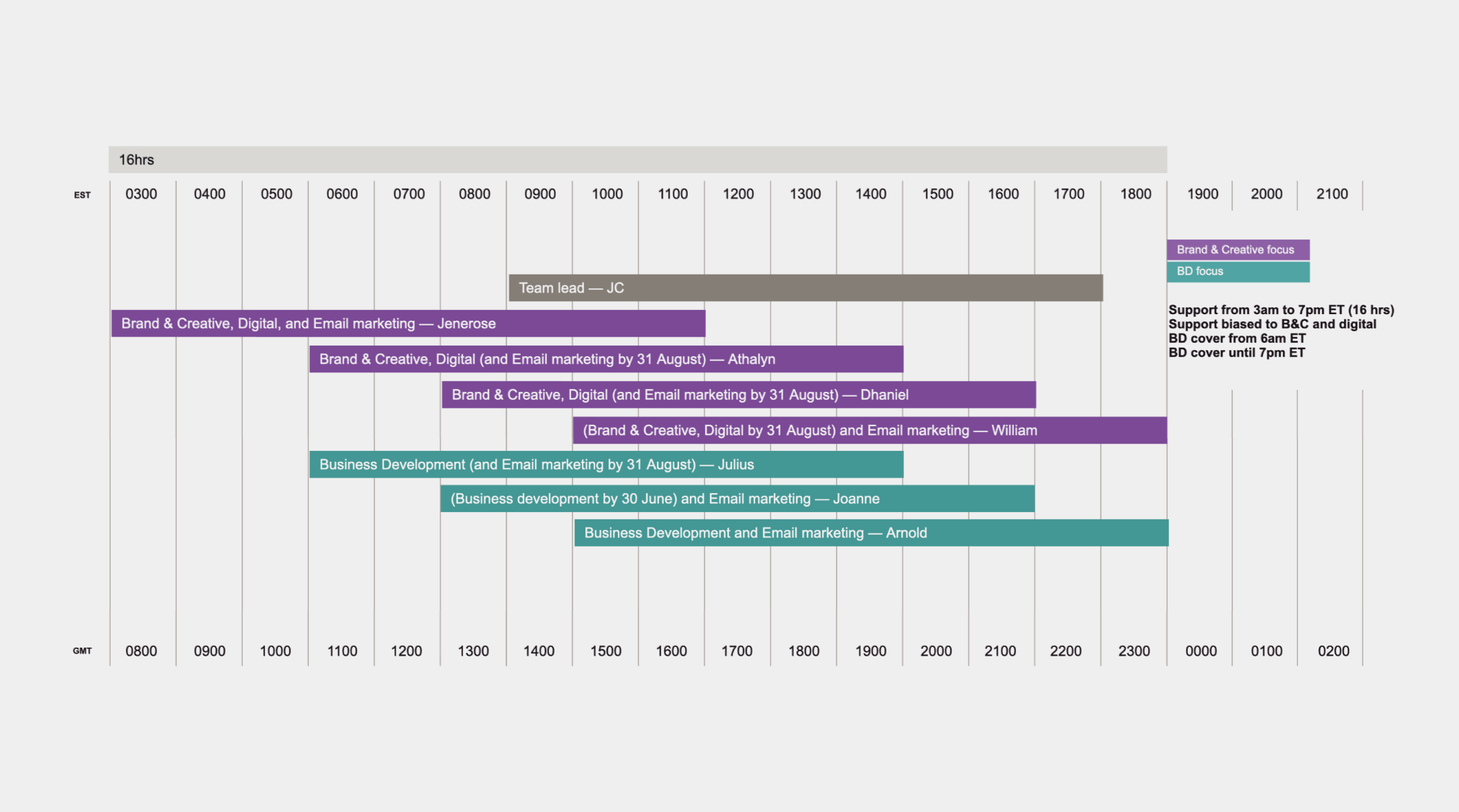
On the operating model, I redesigned the shift structure to extend daily coverage to 16 hours, aligning design and creative resource to peak demand windows in the Eastern Time Zone and building Business Development coverage around validated need rather than assumption. I put in place a four-month cross-training plan to bring the team's capabilities to a consistent level — with particular focus on closing the specialist skills gap — and introduced mandatory peer review across all team members to reduce reliance on self-checking.
I designed a new monthly performance report covering request triage, revision rates, quality findings, and client feedback, giving regional leadership a regular and transparent picture of service health. To improve day-to-day collaboration, I set up a shared channel and standing coordination calls as the single point of contact across central, regional, and delivery teams. The full set of changes was packaged into a clear stakeholder communication issued to regional leadership ahead of the June go-live.
The outcome
The redesigned operating model launched on schedule on 1 June 2026. Regional stakeholders confirmed alignment before go-live, and senior leaders were briefed with confidence — supported by a formal capability assurance summary and documented quality improvement plans. The service moved into a three-month pilot phase, with a full SLA review scheduled for later in the year.
Results
- 16-hour daily coverage activated on schedule, with shifts matched to validated regional demand
- Quality SLA held at 99.9%+ across the six-month review period preceding the new model
- New monthly performance report introduced, giving all regions consistent visibility of service quality
- Four-month cross-training plan in place, with full specialist coverage confirmed from day one of the new model
- Shared collaboration space and standing governance calls established as permanent working practice
Discipline
Creative ops
My role
Global design & creative operations lead
End-to-end redesign of creative services operating model
Practices
Operating model design
Service governance
Stakeholder alignment
Change management
QA framework design
Skills
Senior stakeholder management
Cross-regional service design
Capacity planning
Quality governance design
Impact
16-hour daily coverage activated June 2026
New monthly performance reporting introduced
Brand identity
Rebranding newly combined firm Norton Rose Fulbright#RiskReady — McLaren Racing partnership activationGlobal brand advertising — top 3 global legal brandDesign systems
Office design system — PowerPoint & Word at global scaleModernising website visual design and experience© Michael Dunn — 2026
Work
Global creative services — operating model redesign
The challenge
A global creative services team supporting Business Development across the US and Canada had grown organically over time, without a clearly designed operating model behind it. The result was a service with coverage gaps, inconsistent output quality, limited depth in specialist skills, and no structured reporting to show how well it was performing.
Feedback gathered through structured conversations with senior regional stakeholders surfaced specific concerns: delivery windows that didn't reflect the actual complexity of different request types, insufficient quality checking on some work, and a capability gap in one specialist area following a staffing change. Regional leadership needed confidence that the service was resilient, predictable, and on an upward trajectory — and they needed to be able to communicate that to their own teams.
The work had a hard go-live deadline of 1 June 2026, with contractual implications tied to any permanent changes to delivery commitments.
What I did
I ran a structured review of the service operating model, working with the delivery team lead and regional subject matter experts to map skills, capacity, and coverage against actual demand. A key part of this was a detailed review of delivery timelines by request type — examining each category of creative output (document production, presentations, social media, email marketing) and identifying where committed turnaround times were misaligned to the real complexity involved. Out of this came a clearer tiering framework, separating standard and complex request paths so that timelines better reflected what was actually being asked.
On the operating model, I redesigned the shift structure to extend daily coverage to 16 hours, aligning design and creative resource to peak demand windows in the Eastern Time Zone and building Business Development coverage around validated need rather than assumption. I put in place a four-month cross-training plan to bring the team's capabilities to a consistent level — with particular focus on closing the specialist skills gap — and introduced mandatory peer review across all team members to reduce reliance on self-checking.
I designed a new monthly performance report covering request triage, revision rates, quality findings, and client feedback, giving regional leadership a regular and transparent picture of service health. To improve day-to-day collaboration, I set up a shared channel and standing coordination calls as the single point of contact across central, regional, and delivery teams. The full set of changes was packaged into a clear stakeholder communication issued to regional leadership ahead of the June go-live.
The outcome
The redesigned operating model launched on schedule on 1 June 2026. Regional stakeholders confirmed alignment before go-live, and senior leaders were briefed with confidence — supported by a formal capability assurance summary and documented quality improvement plans. The service moved into a three-month pilot phase, with a full SLA review scheduled for later in the year.
Results
- 16-hour daily coverage activated on schedule, with shifts matched to validated regional demand
- Quality SLA held at 99.9%+ across the six-month review period preceding the new model
- New monthly performance report introduced, giving all regions consistent visibility of service quality
- Four-month cross-training plan in place, with full specialist coverage confirmed from day one of the new model
- Shared collaboration space and standing governance calls established as permanent working practice
Discipline
Creative ops
My role
Global design & creative operations lead
End-to-end redesign of creative services operating model
Practices
Operating model design
Service governance
Stakeholder alignment
Change management
QA framework design
Skills
Senior stakeholder management
Cross-regional service design
Capacity planning
Quality governance design
Impact
16-hour daily coverage activated June 2026
New monthly performance reporting introduced
Brand identity
Rebranding newly combined firm Norton Rose Fulbright#RiskReady — McLaren Racing partnership activationGlobal brand advertising — top 3 global legal brandDesign systems
Office design system — PowerPoint & Word at global scaleModernising website visual design and experience© Michael Dunn — 2026
Work
Global creative services — operating model redesign
The challenge
A global creative services team supporting Business Development across the US and Canada had grown organically over time, without a clearly designed operating model behind it. The result was a service with coverage gaps, inconsistent output quality, limited depth in specialist skills, and no structured reporting to show how well it was performing.
Feedback gathered through structured conversations with senior regional stakeholders surfaced specific concerns: delivery windows that didn't reflect the actual complexity of different request types, insufficient quality checking on some work, and a capability gap in one specialist area following a staffing change. Regional leadership needed confidence that the service was resilient, predictable, and on an upward trajectory — and they needed to be able to communicate that to their own teams.
The work had a hard go-live deadline of 1 June 2026, with contractual implications tied to any permanent changes to delivery commitments.
What I did
I ran a structured review of the service operating model, working with the delivery team lead and regional subject matter experts to map skills, capacity, and coverage against actual demand. A key part of this was a detailed review of delivery timelines by request type — examining each category of creative output (document production, presentations, social media, email marketing) and identifying where committed turnaround times were misaligned to the real complexity involved. Out of this came a clearer tiering framework, separating standard and complex request paths so that timelines better reflected what was actually being asked.
On the operating model, I redesigned the shift structure to extend daily coverage to 16 hours, aligning design and creative resource to peak demand windows in the Eastern Time Zone and building Business Development coverage around validated need rather than assumption. I put in place a four-month cross-training plan to bring the team's capabilities to a consistent level — with particular focus on closing the specialist skills gap — and introduced mandatory peer review across all team members to reduce reliance on self-checking.
I designed a new monthly performance report covering request triage, revision rates, quality findings, and client feedback, giving regional leadership a regular and transparent picture of service health. To improve day-to-day collaboration, I set up a shared channel and standing coordination calls as the single point of contact across central, regional, and delivery teams. The full set of changes was packaged into a clear stakeholder communication issued to regional leadership ahead of the June go-live.
The outcome
The redesigned operating model launched on schedule on 1 June 2026. Regional stakeholders confirmed alignment before go-live, and senior leaders were briefed with confidence — supported by a formal capability assurance summary and documented quality improvement plans. The service moved into a three-month pilot phase, with a full SLA review scheduled for later in the year.
Results
- 16-hour daily coverage activated on schedule, with shifts matched to validated regional demand
- Quality SLA held at 99.9%+ across the six-month review period preceding the new model
- New monthly performance report introduced, giving all regions consistent visibility of service quality
- Four-month cross-training plan in place, with full specialist coverage confirmed from day one of the new model
- Shared collaboration space and standing governance calls established as permanent working practice
Discipline
Creative ops
My role
Global design & creative operations lead
End-to-end redesign of creative services operating model
Practices
Operating model design
Service governance
Stakeholder alignment
Change management
QA framework design
Skills
Senior stakeholder management
Cross-regional service design
Capacity planning
Quality governance design
Impact
16-hour daily coverage activated June 2026
New monthly performance reporting introduced
Brand identity
Rebranding newly combined firm Norton Rose Fulbright#RiskReady — McLaren Racing partnership activationGlobal brand advertising — top 3 global legal brandDesign systems
Office design system — PowerPoint & Word at global scaleModernising website visual design and experience© Michael Dunn — 2026