Brand systems explained

What a brand system is, why it matters to a firm, and how to make the case for one internally.

Written for
Brand, marketing and operations teams
Date
October 2026
Document
Free guide
Start reading

Why it matters

Most people reading a firm’s material are not making a decision today. That material builds the memory that decides the shortlist when they are.

A brand system keeps that memory consistent: the same look and voice every time, whoever made the material and whatever tool they used.

Why now

AI tools now let anyone in your organisation produce client and investor material. The review layer has not grown with them.

More hands, same checks. Fee earners, deal teams, BD and bids teams can now produce documents, decks and posts in minutes. Each tool follows what its files tell it, at volume, and nothing in it notices when something looks wrong. Each miss is found and fixed by hand, after the fact.

Decisions cost least early. The rules set when a DAM, a template set or an AI tool goes in shape everything made after it. They cost least when decided at the start. Changing them later means touching every file.

The numbers behind the case

From sources independent of anyone selling brand software

1in20

Business buyers in the market for a new provider in any quarter.

Ehrenberg-Bass
32

Percentage points faster revenue growth for top quartile design performers.

McKinsey Design Index, 2018
56

Percentage points faster total returns to shareholders, from the same study.

McKinsey Design Index, 2018

What a brand system is

A brand system is the connected set of assets, rules and decision logic that lets a brand come out the same way every time.

Visual identity, verbal identity, brand architecture, governance, templates and components all sit inside it, held in one place and kept current.

A guidelines document is part of a system. An asset library is part of a system. Most firms have bought the parts. Very few have built the thing that holds them together.

Each layer of the system feeds the next

Open a layer to see what sits in it, who owns it and what it hands on.

01Set the standardDesign system layer

Tokens, components and assets in Figma.

Owner
Brand and design team
Held in
Figma
  • TokensColour, type, spacing
  • ComponentsLayouts and templates
  • AssetsLogo, imagery, icons

Hands onFigma MCP carries tokens and components to layer 02.

02Write the rules downDocumentation and AI readiness layer

Guidelines and rules structured so AI tools can follow them.

Owner
Brand operations
Held in
Claude
  • GuidelinesStructured markdown
  • SkillsDesign and writing rules
  • ContextTone, sector, approved claims

Hands onSkills and MCP put the rules inside each tool in layer 03.

03Put it in every handScale and enablement layer

Templates and AI assistants loaded with the rules, so marketing, BD, deal teams and fee earners get it right first time.

Users
Marketing, BD, bids and fee earners
Used in
Canva, Copilot, legal AI tools and agents
  • TemplatesLocked to the tokens
  • AI assistantsLoaded with brand rules
  • Self-serveNo studio queue
  • GovernanceApprovals and overrides

Output toPresentations, documents, bids and pitches, social, web and email.

Signs the system underneath is missing

This held while a few dozen people produced client documents and somebody was always checking. It stops holding when every fee earner and deal team has a tool that produces client material at volume.

Tick each sign that is true of your firm to see what it costs.

The five signs
What it costs the firm0 of 5

Tick a sign to see its cost here.

    Every rule in a system is a design decision

    The guidelines cover the obvious cases. A system has to answer everything else, and each answer needs a designer who can see what the brand needs and stand behind the ruling when a senior person pushes back.

    1. 01

      Which colour is retired, and which is a rule?

      Old files are full of both. Left to a tool, a retired colour becomes a rule and repeats at volume.

    2. 02

      Which layout is a one-off, and which is a pattern?

      One pitch’s layout should not become a template. A layout the firm uses every week should.

    3. 03

      What happens where the guidelines say nothing?

      A chart with seven series. A client’s logo beside the firm’s. A table that runs to four pages. Each needs a ruling before anyone meets it under deadline.

    4. 04

      How far can each office or company flex?

      Too tight and people work around the system. Too loose and it stops being one. The line is a judgement, made once and written down.

    Tested until it holds

    A system is finished when a non-designer gets on-brand output without asking anyone. Reaching that point takes rounds of testing and adjustment that need a designer’s eye.

    1. 01

      Build from real documents

      Templates start from the documents the firm sends most, with real content in them. A tidy sample page proves nothing.

    2. 02

      Fill it the way people will

      Long names, dense tables, co-branded covers and long bids. Filled by fee earners, deal teams and AI tools.

    3. 03

      Break it on purpose

      Every template is pushed until it fails, so the limits turn up in testing and stay out of a client’s inbox.

    4. 04

      Refine and test again

      Spacing, hierarchy and type adjusted in small steps, then tested again with the people who will use it.

    What gets checked before handover. Models redraw logos, invent colours, fall back on safe layouts and recreate graphic devices badly. Every output is tested against that list and corrected before the system is handed over.

    Making the case internally

    One argument for each person in the room

    Pick the person you need to convince.

    Private equity

    One system across the firm and its portfolio

    Operations teams own the problem twice: once for the firm’s own material, and again across every company it holds.

    1. 01

      The firm

      Fundraising decks, investor reports and investment committee papers come out the same way, whoever on the deal or investor relations team made them.

    2. 02

      The portfolio

      One master system that each company inherits, with a defined set of things each one can change. Built and paid for once, at group level, and the group can see what is in use, company by company.

    3. 03

      Acquisition and exit

      A new company joins the system in its first hundred days instead of rebuilding from nothing. At exit, the brand and its rules hand over as a documented asset.

    Questions the case will meet

    01Does consistency make the brand dull?

    McKinsey measured design as a business practice. Top quartile firms stood out because they carried a distinctive idea across everything they made. An idea with no system shows up once in fifty pieces.

    02We already have guidelines

    Guidelines describe the brand. They have no say over what a template, a fee earner, a portfolio company or an AI tool produces. A system holds the guidelines, assets and rules together and keeps them current.

    03Can we generate a system with AI?

    It is worth trying. A model copies whatever is in the source files, mistakes included, and repeats them at volume. The design work is deciding what is right, testing that it holds, getting people to use it and keeping it right.

    What standing still costs

    Indicative UK figures. Move each one to match the firm.

    Correction the brand team fixing other people’s work
    Senior time fee earners formatting their own documents
    £0a year in correction and senior time
    Correction
    £0
    Senior time
    £0

    Brand team cost: ONS ASHE 2025 median for graphic and multimedia designers, £32,510, plus employer National Insurance and pension, over 1,725 hours. Fee earner rate: HMCTS guideline hourly rate, grade C, National 1, January 2026. For private equity, use the loaded cost of a deal team member. Fixed at 46 working weeks a year. Everything else is illustrative.

    Getting started

    Each step produces the evidence for the next. The Pulse is free, and the diagnostic is priced to be signed off on the spot.

    1. 01
      Four minutes, free

      Brand System Pulse

      Twelve questions online, with an instant reading of where the firm stands.

      Take the pulse
    2. 02
      Sixty minutes

      Brand system diagnostic

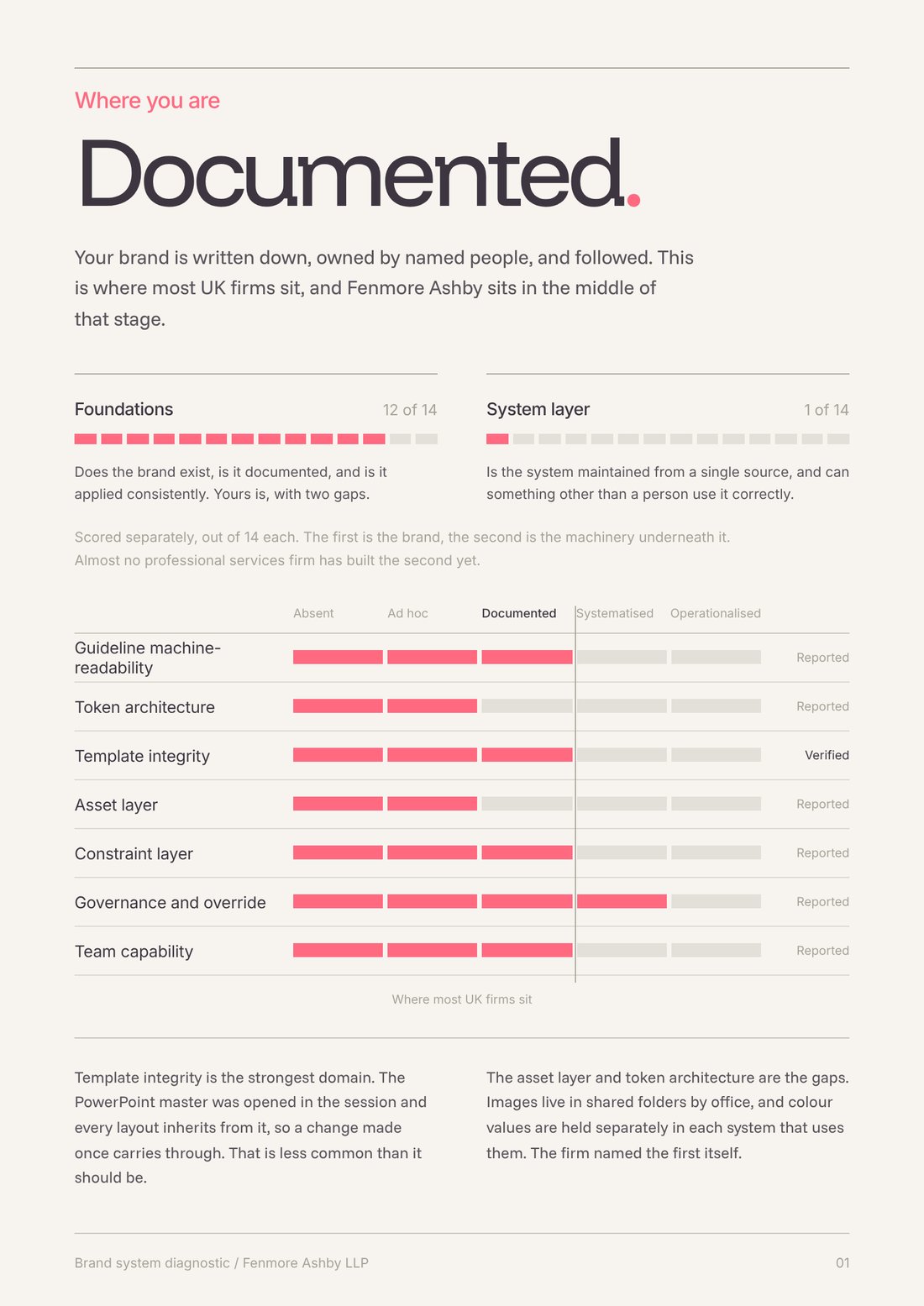
      Seven areas scored live, with a report the firm can act on.

      Book a diagnostic
    3. 03
      Ten working days

      Audit

      The same seven areas, evidenced inside the firm’s systems, with a costed roadmap.

    4. 04
      Scoped from the audit

      Build

      System, templates and tooling, handed over to the firm’s team to run.

    5. 05
      Monthly

      Retained

      Adoption monitored, the system improved on a cycle, training kept current.

    The brand system diagnostic

    Sixty minutes, live, with the brand or operations lead in the room. The report follows within 24 hours.

    1. 01

      A stage for the firm and for each of seven areas, from guidelines to the asset layer

    2. 02

      The three things most likely to cause a problem

    3. 03

      What to fix first, and what it costs

    4. 04

      A report written to circulate inside the firm

    £950 plus VAT, credited in full against the audit if commissioned within 90 days.
    Book a diagnostic

    Page one of a sample diagnostic report for Fenmore Ashby LLP: the stage word Documented, foundations 12 of 14, system layer 1 of 14, and a chart placing seven domains on a five stage track
    Sample report page, for a fictional firm.

    Brand checker

    A brand check before any file goes out

    1. 01

      Write the rules

      The firm’s guidelines become one rules file. Every fix traces back to a rule.

    2. 02

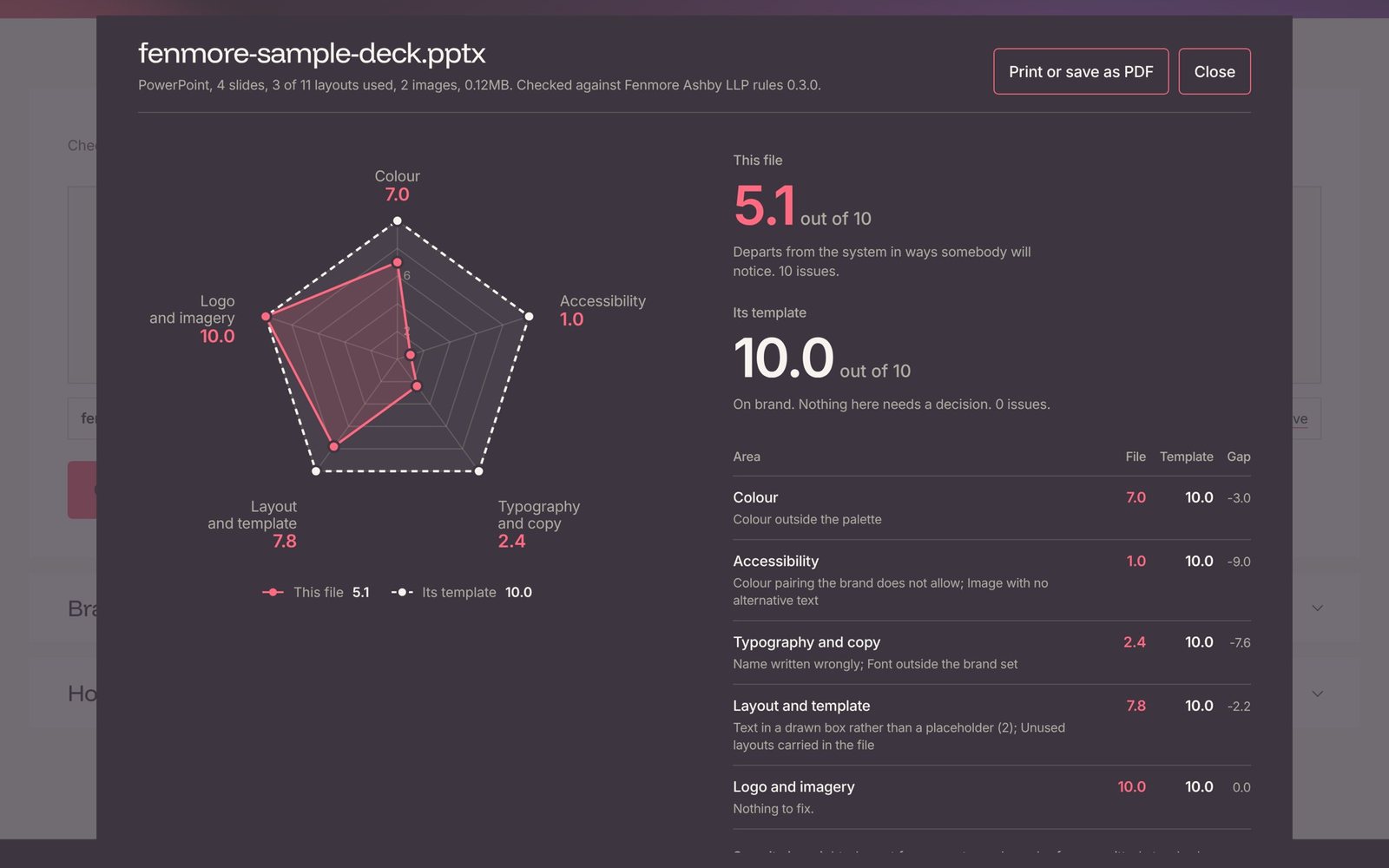
      Check the file

      A deck, document, PDF or image gets a score by area and a numbered list of fixes. No upload, no account, and nothing leaves the machine.

    3. 03

      Own the rules

      The brand team owns the rules file, so the checker changes when the guidelines do.

    Try the brand checker

    The brand checker report for a sample deck: an overall score of 5.1 out of 10 against 10.0 for its template, a chart by area, and a list of fixes for colour, accessibility, typography, layout and logo
    Shown with Fenmore Ashby, a fictional law firm built into the demo.

    Where to go from here

    1. 01

      Take the pulse: a four minute reading of where the firm stands.

      Take the pulse
    2. 02

      Run the cost sums with the firm’s own figures.

      Open the sums
    3. 03

      Share this guide with the people in section 03 before the budget conversation.

      See the arguments
    4. 04

      Book the brand system diagnostic, with the brand or operations lead in the room.

      Book a diagnostic
    MYKD

    Keep a copy to circulate inside the firm.

    Download the PDF

    The full guide as a 23 page PDF, to circulate inside the firm. Download it here, and a link comes to you by email.

    Add your name.
    Add your organisation.
    Check the email address.
    Tick the first box to get the PDF.